Nursery bedding · Buying guide
A Practical Guide to Choosing Nursery Sleep Essentials
Preparing a baby’s sleep space can make a small room feel like a laboratory for decisions: cotton or synthetic, padded or plain, washable or merely reassuringly labeled. The useful questions are quieter and more concrete. Does the mattress fit the crib? Does the sheet stay taut? Can the bedding be washed according to its instructions? And do the materials and claims hold up when you look beyond the front of the package?
Published October 23, 2026
Nursery shopping encourages a particular kind of optimism. A soft coverlet seems to promise comfort; a quilted pad suggests protection; the word “organic” appears to settle questions that, on closer inspection, are not quite the same question. A product can be made from appealing materials and still be the wrong choice for an infant’s sleep space. Safety, fit, composition, care, and claims all deserve their own scrutiny.
The central principle is uncomplicated: an infant’s sleep surface should be firm, flat, and fitted, with no loose bedding or soft objects in the sleep area. A properly fitted sheet is the familiar finishing layer. Add-ons that seem modest—a pillow, topper, positioner, quilt, or loose blanket—can change the character of that surface. Before buying anything, consult current safe-sleep guidance from a qualified public-health source and follow the crib and mattress manufacturers’ instructions. A nursery can be gentle and welcoming without being layered.
This guide focuses on the practical details of nursery bedding: how to assess a crib mattress pad, what organic cotton and GOTS certification can tell you, how to compare construction and care instructions, and how to read marketing language without asking it to answer questions it was never designed to answer. The aim is not to turn a parent into a textile chemist. It is to make the important distinctions easier to see.
Begin with the mattress and crib
Shopping often starts with a fabric swatch, but it should begin with the sleep surface itself. Check that the mattress is designed for the crib or bassinet in use, follows the manufacturer’s specifications, and fits snugly. The mattress should not leave gaps around its edges. A fitted sheet should also be made for that particular mattress size and should remain securely in place at the corners.
Measurements are useful, but they are not a substitute for fit. Product descriptions may list a standard dimension, while the mattress in a particular crib has a different depth, shape, or construction. Confirm the crib and mattress instructions, then test the sheet on the actual mattress. It should be snug, without excess fabric bunching on the surface or an elastic edge that can slip free. If the mattress or sheet has been damaged, stretched, or altered, replace it rather than improvising a fix.
These checks matter before a pad enters the picture. A pad should not make an otherwise well-fitting mattress-and-sheet arrangement loose, uneven, or difficult to secure. Nor should it be used to compensate for a mattress that is too small, worn, or incompatible with the crib. When a product’s fit is uncertain, ask its manufacturer for guidance and compare the answer with the crib and mattress instructions.
What a crib mattress pad does—and does not do
A crib mattress pad is generally a protective layer placed between the mattress and the fitted sheet. Depending on its materials and construction, it may help shield the mattress from routine spills, oils, and everyday wear. Some pads add a lightly cushioned feel; others are designed chiefly as a washable barrier. That can be useful in the ordinary choreography of caring for an infant, when laundry is less an occasional chore than a recurring condition of the household.
Protection, however, is not the same as a safety upgrade. A pad does not make a mattress more appropriate for sleep, and added padding should not be treated as a benefit without considering the complete sleep setup. Check that the product is intended for a crib mattress, follows the manufacturer’s use directions, and permits a snug fitted sheet over it. If the instructions are unclear, do not assume that a product’s “crib” label settles the matter.
Nor should convenience turn into a stack of spare layers left in the crib. Keep the sleep area free of loose blankets, pillows, stuffed toys, and other soft objects. A spare sheet or pad belongs nearby for a change, not loose on the sleep surface. The distinction can seem overly exact until the room is dark, the laundry basket is full, and a tired adult is tempted to solve one practical problem by adding another layer.
Fit is a safety question and a daily-use question
Descriptions such as “snug,” “secure,” and “fits standard cribs” are starting points, not proof. Look for the pad’s stated dimensions, the mattress depth it accommodates, and the way it is meant to stay in place. Compare those details with the mattress in your home. If it has a skirt or elastic edge, inspect whether it is designed to wrap the mattress securely and whether the sheet still fits smoothly over it.
After laundering, check the fit again. Natural fibers can change slightly with washing and drying, particularly if care instructions are ignored. A pad that used to sit flat may shrink or become misshapen; an elastic edge may lose its hold. Follow the label, inspect the product periodically, and stop using it if it no longer lies evenly or fits as intended. The principle is refreshingly domestic: the right product is the one that remains appropriate after it has been washed, not just the one that looked convincing in its packaging.
It is also worth considering the surface beneath the pad. Mattress covers and pads are not interchangeable by default. A pad may be absorbent, water-resistant, or simply quilted; a waterproof barrier may use a separate backing layer. Read the full material description rather than inferring performance from the words “protective” or “natural.” If a waterproof layer is important to your household, verify what creates that barrier and how it should be cleaned.
Organic cotton: a material description, not a complete verdict
Organic cotton is a common choice in nursery bedding because cotton is familiar, washable, and available in a range of weaves and weights. A percale cover, for example, is woven to create a crisp, breathable-feeling fabric. Quilting can hold batting in place and produce a more substantial surface. Neither the word “cotton” nor the adjective “organic,” on its own, establishes how a particular product will fit, feel, wear, or perform in a baby’s sleep space.
Look for the full fiber composition, including both the face fabric and the fill. A cover can be cotton while the batting or backing is made from something else. If the product is described as “100% organic cotton,” check whether that statement applies to the entire item or only to a named component. When a brand supplies a detailed materials list, construction notes, country-of-origin information, and care directions, it gives the reader more to evaluate than a short line of lifestyle language can.
Organic production and vegan status are separate considerations, too. Cotton is plant-derived, but a finished textile product can include other materials in its fill, backing, elastic, or finishing. Wool, for instance, is an animal-derived fiber and would not meet a strict vegan materials preference. Consumers who are checking for vegan bedding should examine every component and ask the manufacturer about anything not identified. A product’s natural or organic credentials do not, by themselves, establish that it is vegan.
What GOTS certification can tell you
Certifications can make a complicated supply chain more legible, but each one has a defined scope. GOTS—the Global Organic Textile Standard—is a textile standard covering organic fibers and certain environmental and social criteria in processing and manufacturing. A GOTS certification can be useful evidence about the certified product or facility within the standard’s scope. It is not a universal endorsement of every quality a shopper might value.
In particular, GOTS does not tell you whether a pad is the right size for your crib, whether it keeps a sheet securely fitted, or whether it should be used under the instructions for a specific mattress. It does not replace checking product construction or care directions. And a reference to organic cotton is not necessarily the same as a current, verifiable certification for the finished product. Look for the certification claim in the context of the item, and consult the standard’s own resources if you need to establish exactly what has been certified.
A useful way to read a label is to separate its statements into categories: what the item is made of; how it is constructed; what has been certified; where it was made; and how it must be cared for. Those are related facts, but they are not interchangeable. “Organic,” “breathable,” “chemical-free,” and “safer” can sound like a single promise. In practice, each requires its own evidence, and broad claims deserve particular care.
A product example: details worth checking
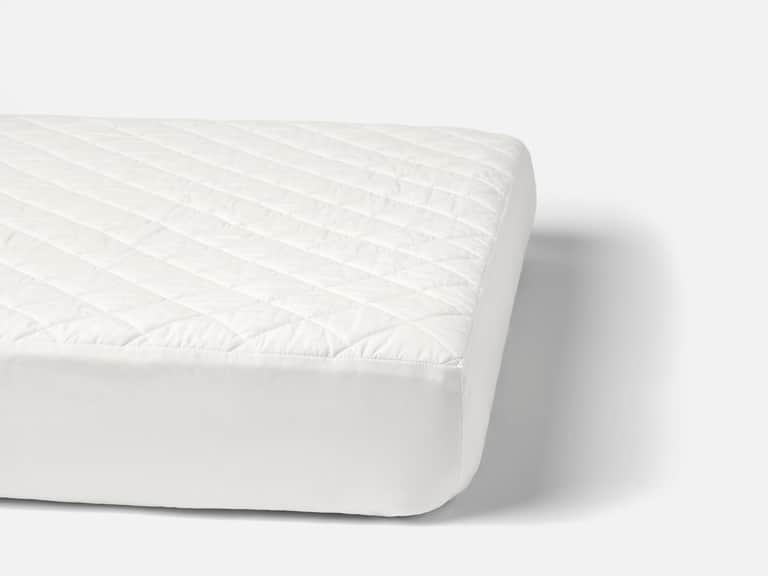
The Organic Crib Mattress Pad is described as cotton inside and out, with a 220-percale cover and two-inch quilted squares. Its listing identifies GOTS certification, says it is made in India, and gives machine-washing directions: cold water on a gentle cycle, followed by low tumble drying. Those are the kinds of details a shopper can compare against household needs—fiber composition, construction, origin, certification, and care—rather than relying on a general impression of “natural” bedding.
The listing gives dimensions of 28 by 52 by 8 inches. Because product dimensions and compatibility can be presented in ways that are not immediately clear, confirm the pad’s intended fit with its manufacturer and compare it with your actual mattress and crib instructions before use. Do not assume a nominal crib size guarantees a secure fit in every crib. The key test remains practical: the pad should be appropriate for the mattress, lie smoothly, and allow a fitted sheet to remain secure as directed.
Product details can inform a decision, but they do not replace safe-sleep guidance or a fit check at home. Nor does a certification make a product suitable for every use. Treat the listing as a set of claims to verify and interpret—not as a shortcut around the fundamentals.
Care instructions are part of the purchase
For nursery bedding, washing is not a footnote. A pad that needs special handling may be less convenient for a household than one that can be laundered routinely. Before buying, note the recommended water temperature, cycle, detergent guidance if supplied, and drying method. “Machine washable” is helpful information, but it is incomplete if the item must be washed in a specific cycle or dried carefully to preserve its shape.
Follow the label rather than choosing the hottest or most aggressive setting by reflex. Excess heat can shrink fabric, damage elastic, or affect a water-resistant backing. Avoid assuming that a scented spray, disinfectant, or other treatment is appropriate for a baby’s bedding. If the manufacturer provides specific cleaning guidance, follow it; if a spill cannot be cleaned within those directions, ask the manufacturer whether the item remains usable.
It helps to have a small, manageable rotation of correctly fitting sheets and any permitted, properly fitted protective layers, rather than a large collection of pieces that do not quite fit. Laundry planning is an unglamorous part of nursery design, but it is also a way to keep the sleep surface simple: replace a soiled item with a clean, secure one, and leave the crib free of extras.
How to evaluate claims without getting lost in them
Baby products arrive wrapped in reassuring language. Some claims are precise; others are atmospheric. “100% cotton” is a composition statement. “GOTS certified” refers to a named standard, though the scope should be checked. “Breathable” may describe a material or construction, but it does not establish that the item is safe in every sleep setup. “Non-toxic” and “chemical-free” are broad phrases that can be difficult to interpret without detail about testing, substances, or criteria.
When a claim matters to you, ask what evidence supports it. Is the fiber identified by component? Is a certification named and current? Does the manufacturer explain what “waterproof,” “hypoallergenic,” or “chemical-free” means for this product? Are care directions and origin details available? A brand that answers clearly gives you something concrete to assess. If a claim is vague, do not let the typography do the work of evidence.
There is a further distinction between material preference and health promise. Choosing organic cotton may reflect a commitment to agricultural or textile standards, a preference for a particular fiber, or both. It should not be presented as a guarantee that an infant will sleep better or that a medical problem will be prevented. For concerns about allergies, skin conditions, temperature, or sleep, consult a pediatric health professional rather than asking a product label to serve as a diagnosis.
A short buying checklist
- Confirm the mattress and crib compatibility. Follow the manufacturers’ instructions and verify that the mattress fits snugly in the crib.
- Check the pad’s intended dimensions and fit. Do not rely on a generic “standard” label when the actual mattress can be measured and checked.
- Read the complete materials list. Look at the cover, fill, backing, elastic, and any other listed components.
- Separate certification from performance claims. A textile certification does not establish fit, sleep safety, or suitability for a particular crib.
- Review care instructions before purchasing. Choose a product you can wash and dry as directed in your household routine.
- Keep the sleep space uncluttered. Use only items permitted by current safe-sleep guidance; do not add loose bedding or soft objects.
- Recheck after washing. Discontinue use if a pad shrinks, loses its shape, or no longer fits securely.
- Ask about unclear claims. Request specifics from the manufacturer instead of assuming that broad terms have one standard meaning.
The quiet art of choosing less
There is a temptation to make a nursery feel complete by filling it. A mattress protector, another pad, a decorative blanket, a pillow for later, a toy for the corner of the crib: each object has a plausible story, and together they can make the room look more prepared than it is. But a baby’s sleep space benefits from a more exacting kind of preparation. The mattress should fit. The sheet should stay put. Bedding should be easy to care for, and the sleep area should remain clear of unnecessary layers.
Material choices still matter. A family may prefer organic cotton, want to understand the provenance of a textile, or need bedding that fits a vegan or sustainability-minded household. Those are legitimate criteria, and careful product information can help answer them. The point is to keep these preferences in their proper place: alongside, not instead of, safe fit and straightforward use.
Choosing nursery sleep essentials is therefore less about finding a single perfect label than about making a sequence of modest checks. Read the composition. Understand the certification. Measure the mattress. Read the wash instructions. Ask questions where the language is vague. Then keep the crib simple. In a room designed for a new arrival, restraint can be a kind of care—quiet, practical, and more useful than another decorative layer.
This article is general consumer information, not medical advice. For current infant safe-sleep recommendations, consult your pediatric health professional and relevant public-health guidance, and follow the instructions provided by the crib and mattress manufacturers.