Materials & Mattress Design
Inside Naturepedic’s Organic Sleep Design: Cotton, Latex, and Construction
A mattress can look like a single, quiet object. In use, it is a small architecture: fibers, foams, seams, and layers negotiating between the sleeper and the bed frame. Naturepedic’s organic materials make that architecture easier to inspect—but organic, natural, and vegan are not synonyms. Understanding the distinctions means reading beyond the label and asking what each layer is made to do.
Published November 8, 2026
Mattress shopping has a way of turning simple questions into vocabulary tests. Is the surface breathable? Does the foam contain latex? What does “organic” certify, and what does it leave untouched? A person trying to make a vegan choice may encounter still another question, often tucked into the material list: does the product contain wool, silk, down, or some less obvious animal-derived component?
Naturepedic’s sleep products are often discussed through the materials that give them their character, especially organic cotton and latex. Those names, however, describe only a starting point. A cotton cover does not tell us what is inside the mattress. A latex core does not explain its firmness, its construction, or the materials that surround it. And an organic claim, however meaningful, does not by itself establish that a product is vegan.
The most useful way to approach an organic mattress is as a set of decisions rather than a single virtue. Which fibers form the cover? What gives the bed its support? How is the filling held in place? What certifications apply to which components? When a company makes a vegan claim, what exactly has been assessed? These are not adversarial questions. They are the ordinary questions a well-informed buyer asks of an object intended to share a bedroom for years.
Cotton: the surface is part of the design
Organic cotton is often the most visible material in a mattress: the fabric one touches before the layers beneath begin their work. Its role is not merely decorative. A cover contributes to the first sensation of softness, affects how air moves at the surface, and protects the construction inside. Depending on the weave and quilting, cotton can feel crisp, smooth, or gently textured. The word “cotton” alone, though, cannot predict that experience. Weave, weight, stitching, and what lies beneath all matter.
In product descriptions, it is worth distinguishing the cotton cover from the mattress’s entire material composition. A cover may be organic while a comfort layer contains another material; conversely, a mattress may use cotton in more than one place. Look for a component-by-component description rather than relying on a headline phrase. If the company identifies the cover as organic cotton, note whether it names a certification and whether that certification applies to the finished textile, the fiber, or a particular stage of production.
GOTS—the Global Organic Textile Standard—is commonly used to assess organic textile processing and related environmental and social criteria across a defined supply chain. It can be valuable evidence about certified textile components. It is not, by itself, a declaration that a complete mattress is vegan, nor does it automatically certify every material in a product. The certification’s scope matters. A label is most informative when the product information makes clear which component it covers.
Cotton also illustrates why comfort is not reducible to a materials checklist. Two beds can use organic cotton and feel quite different because of their thickness, quilting, tension, and the support system beneath. Someone who sleeps warm may pay attention to surface breathability; someone who wants a smoother feel may focus on the cover’s construction. Neither preference can be settled by the word “organic.” The material is relevant, but the assembly gives it purpose.
Latex: resilience, contour, and the shape of support
Latex occupies an unusual place in mattress language. It is often described as buoyant, responsive, or contouring, terms that suggest a surface that yields without swallowing the sleeper. Natural latex is made from rubber-tree latex; in a mattress, it may appear as a solid core, a layer, or a filling arranged inside a cover. The precise feel depends on the latex itself and on how it is formed, layered, and paired with the rest of the construction.
That distinction between material and construction is easy to miss. A thick latex layer may change pressure relief and the sense of cushioning. A firmer support core may contribute more to the bed’s overall stability. Layer order affects how the sleeper encounters the materials: a soft upper layer and a firmer base do not feel the same as the same materials arranged in reverse. Even within a category such as Dunlop latex, descriptions should be read for thickness, density or firmness information where available, and the role assigned to the layer.
GOLS, the Global Organic Latex Standard, is a certification relevant to organic latex and its processing chain. It is useful evidence when a product names certified organic latex, but it should not be mistaken for a complete report on every component of a mattress. Nor does organic sourcing alone resolve questions about animal-derived materials elsewhere in the design. The practical habit is to match each claim to its subject: certified latex, certified cotton, and a finished product’s vegan status are separate statements, even when they appear together on one page.
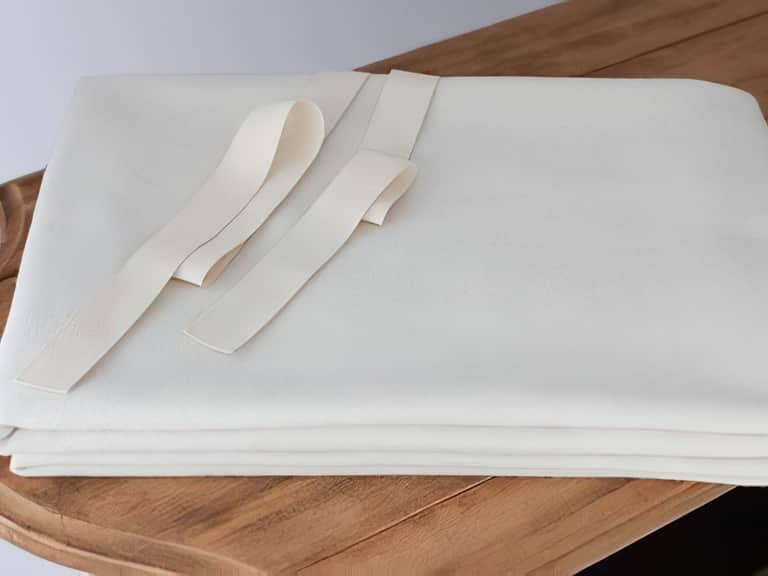
One Naturepedic product that makes these distinctions concrete is the Naturepedic Box-Stitched Organic Latex Topper. It is a three-inch topper, rather than a complete mattress, with a GOLS-certified organic Dunlop latex filling and a GOTS-certified organic cotton cover. Its product details also list the filling as 95 percent latex and 5 percent polyester, and identify the topper as Vegan Certified. The percentage matters: “latex topper” does not mean every part of the filling is latex, and a careful materials description lets the reader see the additional component rather than infer a simpler composition.
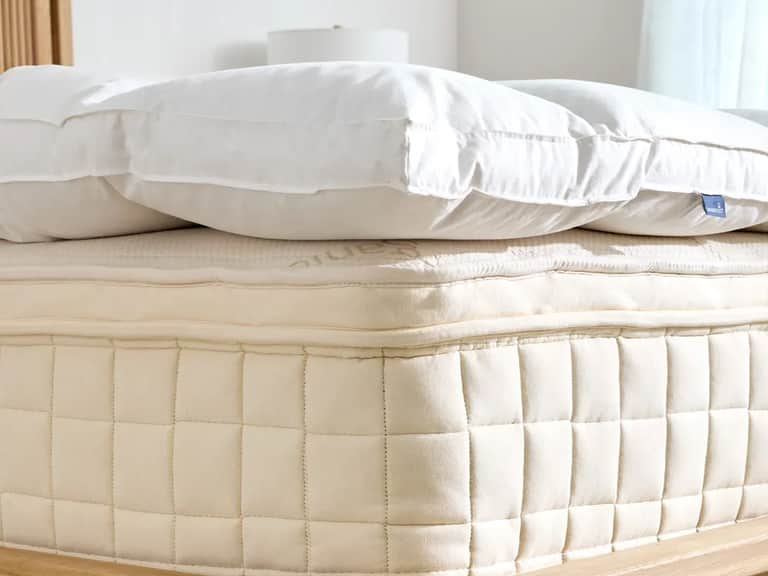
The topper’s box-stitched construction is intended to keep filling distributed across the surface. That is a functional choice, not just a tidy seam pattern. A filling that shifts or gathers can create unevenness; compartments can help restrain movement. The product information also describes a three-inch depth, a cotton percale encasement, and care by spot cleaning rather than machine washing. Those details influence what the topper is like to use and maintain. A topper can soften or otherwise alter the feel of an existing mattress, but it cannot correct every issue with an unsuitable support base.
A mattress is a construction, not a material name
The term “organic mattress” is tempting as a shortcut. It sounds as if the whole object has been reduced to a single, legible principle. In reality, a mattress is assembled from components that perform different jobs. The cover encloses. The comfort layers cushion. The support structure bears weight. Quilting, adhesives, barriers, and fire-safety components may also be part of the design. A transparent description makes those layers easier to distinguish.
For the buyer, this means reading product pages as construction documents in miniature. Start with the layer list. Identify the core, comfort layers, cover, and any stated barrier or fire-safety materials. Look for thicknesses and firmness descriptions, then compare them with the dimensions and construction of the bed you already have. If a description gives only a broad phrase such as “natural materials,” it is reasonable to seek more detail. If it names a component but not its composition, ask whether the company can clarify.
Support and comfort are related, but they are not interchangeable. A mattress may feel plush at the surface while providing a more stable underlying base; another may feel firm from the first contact. The appropriate combination depends on body shape, sleep position, personal preference, and the frame or foundation beneath the mattress. Material names can help a shopper understand likely behavior, but they do not replace a trial or a careful assessment of fit.
Durability is similarly a property of the assembled product, not a promise hidden in the prestige of one fiber. Latex is known for resilience, but the longevity of a mattress depends on its design, use, maintenance, and the quality of its components. Covers and comfort layers experience different stresses from support cores. A clear warranty and care guide can help set expectations; neither should be treated as proof that a mattress will suit every sleeper indefinitely.
Organic is not the same as vegan
Here is the distinction that matters most to a vegan buyer: organic describes standards for how certain materials are produced or processed; vegan describes the absence of animal-derived materials, and may also involve questions about testing and manufacturing practices. A certified organic mattress can contain wool. Wool may be organic and responsibly sourced and still be an animal product. Likewise, cotton can be plant-based without the finished item being vegan if another component uses an animal-derived material.
Wool is especially common in bedding because it can be used as a layer or as part of a fire-safety strategy. It is also an easy example of why “natural” is not a synonym for “vegan.” A wool-filled topper or wool-wrapped mattress may appeal to shoppers looking for natural fibers, but it does not meet a strict vegan materials preference. The same scrutiny should extend to less conspicuous items in the construction, not only the surface fabric.
Vegan claims, too, should be read with care. Ask whether the claim applies to the full product or only selected materials, whether it has been certified by a named organization, and what the certification’s scope covers. The Naturepedic latex topper described above lists Vegan Certified alongside GOTS and GOLS certifications. These designations address different questions: the vegan certification concerns vegan status, while GOTS and GOLS relate to organic textile and latex standards. One does not stand in for the others.
It is sensible to treat a certification as evidence with boundaries, not as a magical word that settles every ethical question. Certifications can help make claims more legible and provide a framework for assessment. They do not necessarily answer every question about labor, environmental impact, transport, packaging, or a company’s entire supply chain. A reader can value certified materials while still asking what is covered and what remains outside the claim.
How to read a product page without getting lost
Product pages often place evocative language beside technical detail. “Cloudlike,” “clean,” and “natural” may help establish a mood; a useful materials list helps establish what the object contains. When comparing Naturepedic or any other organic mattress design, move from the mood words to the construction particulars. A little method can make a dense page feel less like a brochure and more like a set of answers.
- List every named material. Separate cover fabric, filling, foam, core, quilting, and any barrier or fire-safety component. Do not assume that a familiar headline material accounts for the entire product.
- Match each certification to a component. Note whether GOTS or GOLS applies to the cotton or latex, and whether a separate certification addresses vegan status or other concerns.
- Check for animal-derived materials. Wool, down, silk, and other animal-based fibers may appear in products described as natural or organic. If the list is incomplete, ask the manufacturer.
- Look for construction information. Thickness, layer order, firmness, stitching, and the type of core help explain how the product is intended to feel and function.
- Read care instructions before buying. A product that must be spot-cleaned or protected from moisture calls for a different routine from a washable pad. Maintenance is part of ownership, not fine print to discover later.
- Check the limits of the claim. “Organic,” “chemical-free,” and “vegan” are not interchangeable descriptions. Look for clear definitions and, where relevant, independent certification.
This checklist is particularly useful when a product page presents several standards together. Certifications can look like a chorus, each badge adding reassurance, but their meanings do not merge. One may concern organic textile processing, another latex sourcing, another emissions or product ingredients, and another vegan status. Reading the names individually is less dramatic than admiring a row of seals, but more informative.
What the label cannot tell you about sleep
Materials can suggest how a mattress might behave; they cannot predict, with perfect fidelity, how any particular person will sleep on it. A latex layer may feel springy to one sleeper and simply supportive to another. A cotton cover may be cool to the touch, while the complete bed’s warmth depends on the sleeper, the room, bedding, and the mattress’s other layers. Claims about airflow and temperature regulation describe design intentions and material properties, not a guarantee of comfort in every bedroom.
For that reason, a good buying decision combines material literacy with ordinary bodily evidence. Consider whether you tend to sleep on your side, back, or stomach; whether pressure at the shoulders or hips is an issue; and whether you prefer a surface that yields readily or one that feels more buoyant. Review the return terms, trial period, warranty, and foundation requirements. Those practical conditions often matter more than another adjective on the product page.
When evaluating a topper, begin with the mattress underneath. A topper can change the uppermost feel, add cushioning, and make a surface more responsive, but it does not turn every underlying mattress into the same bed. The Naturepedic box-stitched latex topper, with its three-inch latex filling and cotton cover, is an example of a separate layer designed to modify an existing sleep surface. Its construction and vegan certification may be relevant to a shopper, while its depth and care requirements are equally important to daily use.
The quieter virtue of transparency
The appeal of organic sleep design is not that a mattress can be made to stand for every virtue at once. It is that a buyer can begin to see the choices inside it. Cotton is not just a comforting word; it is a textile with a place in the construction and a certification scope that can be checked. Latex is not merely a natural alternative; its form, thickness, and location influence the feel of the bed. A stitched enclosure is not a footnote; it can help keep filling where the design intends it to remain.
For vegan shoppers, transparency is what turns an attractive materials story into something usable. The central question is not simply whether a product is organic, nor whether its principal layer is plant- or mineral-derived. It is whether all relevant components and claims are disclosed well enough to make an informed choice. A product can be organic without being vegan; it can be vegan without being entirely organic; and certifications may address one part of that picture while leaving another to be verified separately.
The best product description does not ask the reader to surrender judgment. It gives the reader enough information to exercise it: a material list, a description of construction, a clear account of certification, and practical details about care and use. In a category where “natural” can mean many things and “clean” can mean fewer still, that plain inventory is its own kind of design.
So the useful way into Naturepedic’s organic sleep design is neither reverence nor suspicion, but attention. Follow the cotton from cover to certification. Follow the latex from source claim to layer and construction. Then look for everything else: the stitching, the supporting materials, the care instructions, and the precise scope of a vegan claim. A mattress may be a quiet object, but it need not be an obscure one.